
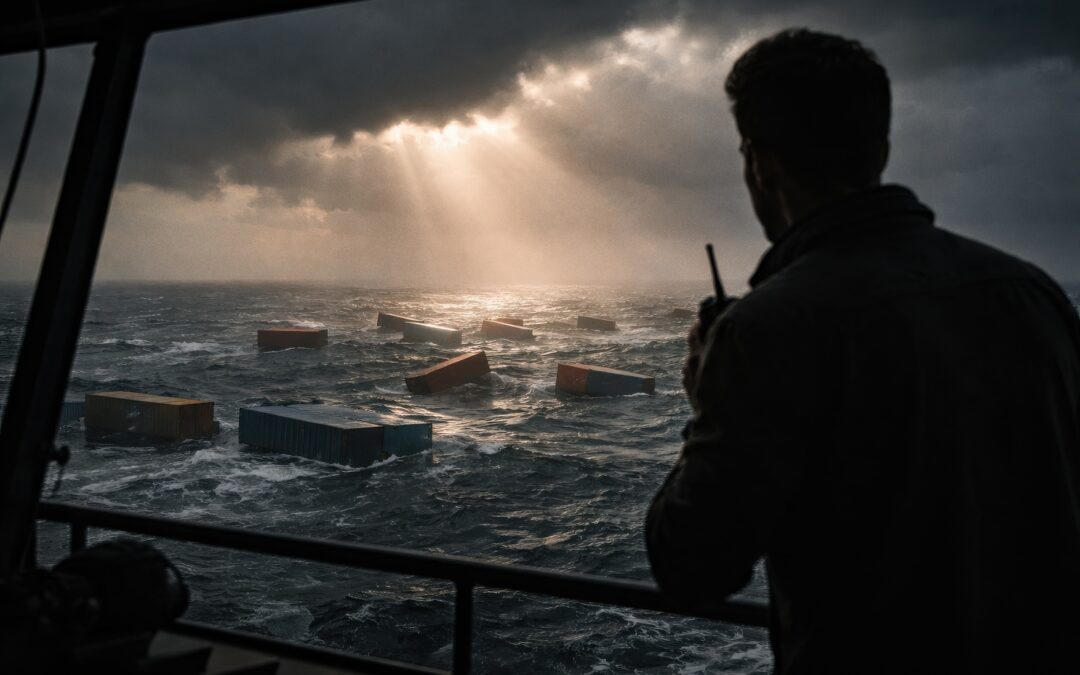
The first two weeks of March 2026 were, to put it mildly, the most turbulent stretch our business had faced in recent memory. We had just closed record numbers in January and February. After two years of absorbing blow after blow, we were finally on the road back. Building the house brick by brick, as I kept telling my team. And then the phone lit up with news that war had broken out in the Middle East.
135 containers on the water.
That was the number my mind locked onto. 135 containers, somewhere between ports, in a corridor that had just become the centre of the world’s attention. No clarity on routing. No certainty on timing. Shipping lines scrambling. My head running through every permutation I could think of. Some containers were called back. Some reached their destinations without disruption. Some were still finding their way. But in those first hours, none of that was known, and the unknown is where anxiety lives.
What I kept coming back to, almost instinctively, was this: what happens to us is happening to everyone in this trade. Panic is a choice, and as the person my team looks to, it is not a choice I could afford. If I broke, they would break. So I held. Not because I was not afraid, but because fear and function can coexist if you decide they will.
And beyond all of it, beyond the shipments and the routing changes and the financial exposure, there were the people. Hundreds of thousands of people who had built their lives in that region. Who had moved there with ambition and hope, who called it home, who had chosen it precisely because it felt removed from conflict. Suddenly finding themselves at the center of it. Human trauma does not resolve on a spreadsheet. It lingers for lifetimes. Events like these become part of the record, and the record shapes everything that follows.
I was in Kenya when the conflict escalated. My flight to Dubai was cancelled, and I had to reroute back to India through Nairobi. Options were limited, but I found a way home. That was stage one. My grandfather and my wife were anxious until I walked through the door. It happened to coincide with Holi, which gave me one day of stillness before the full weight of what needed to be managed arrived. That one day mattered more than I expected.
The messages started pouring in. Mailers from every direction, information of every quality, and questions my senior management needed answered before I had answers to give. There were moments where the pressure condensed into something sharp, and I let it out on my wife, which she handled with more grace than I deserved. She reminded me, simply and clearly, that I was not alone in this, and that whoever had authored this particular chapter of our story had done so because he believed we could carry it. That shifted something. The brain started working rather than spinning.
We divided the situation into three stages. What was in transit. What was sitting at ports. What was still in production.
Production was the first to address, and in theory the most straightforward. Stop new runs, hold capacity, wait for clarity. But even that carried weight.
My customers rely on us to keep their factories moving. Cutting off supply does not just affect their inventory. It affects their workers, their obligations, their ability to function. So rather than a hard stop, we placed those orders on standby with a commitment to ramp back up the moment shipping lanes reopened. In most cases, we followed through.
My suppliers have their own machines to run. They had stood by us through difficult stretches before, absorbed delays and adjusted plans without complaint. Walking away from them cleanly the moment conditions turned difficult would have been a poor way to honour that relationship. We stayed in communication. We stayed honest.
And my own team needed to know we were not going anywhere. That their security was not in question. That we would come out the other side of this intact, and that the same force that had put us through the difficulty was doing so because it knew we were built for it.
The port situation required something different from me entirely. It required me to let go. My team, and I say this with genuine admiration, found information through channels I could not have navigated myself. Shipping line websites were down. Phones rang without answer. And yet they tracked, they followed up, they pieced together the picture container by container. Leadership is knowing when the best thing you can do is get out of the way and let good people work.
What we did with that information was straightforward in principle. We were transparent with customers about what had happened and what it meant. We helped redirect containers to safer ports where that was possible. We kept everyone informed as the situation developed rather than going quiet when the news was not good. That last part matters more than people realise.
The containers in transit were the hardest to sit with. Because there was genuinely nothing to do about them. And I had to make peace with that. I cannot control what is outside my control. I can only control what is in my hands, make the best decisions available to me, and then go with whatever the rest becomes. Some cargo was offloaded in Singapore. Some in Colombo. Some reached Mundra. Some lines honored their original voyages as best they could under the circumstances. The picture assembled itself slowly, imperfectly, but it assembled.
When the pandemic arrived in 2020, I was a different version of myself. Quicker to panic, slower to steady. This time I made a deliberate decision to be composed, not because the stakes were lower but because I had learned enough in the years between to know that a calm mind genuinely does analyse better. The goal through all of it was a solution that worked for the customer, the supplier, and us. Not every situation allowed for that. But I kept reaching for it.
I stayed away from the news channels. That was a conscious choice. Twenty-four-hour coverage of conflict is designed to keep you attached and anxious, and anxiety was the last thing I needed more of. I found a quiet stability instead in the people closest to me, particularly my wife and mother-in-law, who between them provided more grounding than any amount of strategic thinking could have.
The war disrupted the recovery we had worked toward. It put the near future in genuine doubt. But I have come to believe, and I am not alone in this belief, that new paths emerge from exactly these moments. His Highness Sheikh Mohammed bin Zayed Al Nahyan, the ruler of the United Arab Emirates, said as much in the context of his country’s response, and I drew something from that. The composure with which the Gulf states absorbed pressure without escalating further, the resilience held alongside real responsibility, that is a model worth carrying.
Growth will come. New markets will open. The plan is already in motion, even when I cannot see the full shape of it. I trust that.
We pray for humanity. For the few who divide the world in pursuit of power, may clarity arrive before more is lost. We are a species that began with nothing, no shelter, no fire, no certainty of food, and we have arrived at a point of extraordinary complexity and capability. The least we owe ourselves is to protect what got us here.
This is my memoir.
What Varanasi Took From Me
My last piece was about stepping away from the familiar, about unlearning the frame. This one follows naturally from there. Varanasi has been the spiritual centre of our civilisation for longer than most cities have existed. People arrive from every corner of the...
Unlearning the Frame
In November 2021, a year into the pandemic, I decided to finally act on something I had been circling for a while. Wildlife photography. My daughters had arrived in July that year, and my wife had travelled to Bangalore for six weeks to be with her mother, to find...

Why I Sell Paper
People ask me all the time. The question arrives at dinners, at networking events, on flights, in the middle of conversations that are going perfectly well until it does not. What do you do? I sell paper. The reaction is always the same. A pause. A slight tilt of the...
The Weight of Norms
I have always believed my childhood was difficult, though the memories have softened with time into something more like impressions than clear images. There was pressure. There was competition. Excellence was the baseline expectation, and falling short of it had...